
Every once in a while I see the question online: Were Wyatt Earp and Doc Holliday lovers?
Let me make the case that the answer to this provocative question could plausibly be yes.
Note: If you have a problem with this concept, that is a you problem. Wyatt Earp would not have had a problem with it. John Flood, Wyatt’s volunteer office manager/secretary/biographer—the only person he absolutely trusted with his life story, was gay.
First discovered by Deirdre Robinson 1 , John Henry Flood Jr. and Edgar Everett Beaver lived together in a committed relationship for decades, only parted by death.
They are on multiple US Censuses together as lodgers, but on the 1940 US Federal Census they actually identify as Head of Household and Partner. John is Edgar’s next of kin on his World War II Draft Registration Card. When John died in March 1958, Edgar died that November.
Wyatt Earp considered John Flood a close friend and, according to some, a surrogate son. Flood thought Wyatt was absolutely awesome.
Okay.
Wyatt Earp and Doc Holliday. You can’t think of one without the other. They were definitely close friends. But were they lovers?
We have already established that the Earps and Holliday grew up in a time without labels, where intense, romantic relationships between people of the same sex were considered normal. Or rather, were not a cause for concern, because the use of “normal” and “abnormal” to describe people didn’t become A Thing until the late 19th/early 20th centuries.
Bearing that in mind…
Much has been written about this iconic friendship, but most of it emphasizes how weird or extraordinary it is that these two disparate people even shared an acquaintanceship, let alone a friendship.
Yet contemporaries saw close similarities between them.
“Wyatt, in many respects, was “Doc” Holliday’s twin. Both were courteous, both resented inquisitiveness….” 2
So why do we think of them as different?
Doc’s reputation—as spread by sensation-seeking newspapers—grew steadily worse over time. Especially after he died and could no longer defend himself.
Wyatt was being libeled by the papers, as well, which he dealt with by withdrawing as best he could from media attention and actively guarding his privacy. But whenever asked, he did try to present Doc in a good light.
When Walter Noble Burns contacted Wyatt in 1927 on the pretense of writing a book about Doc Holliday, Wyatt immediately responded with help.
One letter from Burns to Wyatt, asking for clarification on some points about Doc, was forwarded to Wyatt out at his mining camp. Normally Wyatt would send his letters to John Flood to be typed and then sent along. This letter he responded to by hand. Eleven pages.
“I wanted to get this away to you as soon as possible. So I did not wait to send it to Los Angeles to have it typed. But hope you will be able to read it. I am sending it by express, so as to make sure you will get it….”3
He also writes that he will be happy to read the book once it’s finished.
I think Wyatt hoped this book would change the narrative and restore Holliday’s honor. So his intense sense of betrayal when the book turned out instead to be about the Earps in Tombstone is understandable.
Doc’s character was portrayed much the same as the newspapers made him out to be, but with Walter Noble Burns’ Tombstone, Wyatt became a hero, literally called “The Lion of Tombstone.”
When Stuart N Lake came around, Wyatt’s wife Josie stressed to him, as she did to everyone, that Wyatt hadn’t been all that close to Doc. She snuck in comments to this effect when she was writing letters to Lake that Wyatt dictated, and after Wyatt’s death she was even more emphatic.
John Clum, editor of the Tombstone Epitaph, praised Wyatt to Lake, while saying he [Clum] had never approved of Holliday.
In 1907, Bat Masterson had famously re-cast the Doc-Wyatt friendship as being one-sided:
“[Doc’s] whole heart and soul was [sic] wrapped up in Wyatt Earp, and he was always ready to stake his life in defense of any cause in which Wyatt was interested….”4
Bat wrote nothing about how Wyatt felt, other than he and Doc were “fast friends.”
This distancing of Earp and Holliday worked. In Stuart Lake’s influential biography of Wyatt, Wyatt Earp, Frontier Marshal, their friendship was labeled as an “extraordinary association”. Extraordinary as in odd. That assessment has rarely varied since.
Modern researchers have pointed out that Doc and Wyatt didn’t know each other for very long, that both had separate groups of friends, and that maybe their friendship wasn’t as intense as it was previously made out to be.
And yet…
In that same 1907 article referred to earlier, Bat Masterson summarized Doc with the sentence:
“Damon did not more for Pythias than Holliday did for Wyatt Earp.”5
Damon and Pythias were two men who loved each other equally.
This undermines Bat’s assertion that Doc’s feelings were one-sided. Damon and Pythias’ story was the subject of a play very popular at the time, so Bat would have known this.
Is his statement a nod to something Bat otherwise would never say?
Wyatt was a private person, and his friends understood that. After Wyatt died, in the course of researching Frontier Marshal, Stuart Lake reached out to Fred Dodge, a friend of the Earp boys.6 Fred Dodge wrote back:
“…I was fully aware of the situation between Doc and Wyatt. … If Wyatt has not told you, out of respect to his memory I will say nothing more about Doc Holliday, except to tell you the place where he died.”7
I find that … very interesting.
Frank Waters, who purposely wrote The Earp Brothers of Tombstoneto explode the squeaky-clean image of Wyatt as the heroic “Lion of Tombstone”, in his book describes “the strange, close relationship between Wyatt Earp and Doc Holliday”8 and “the close and constant intimacy between Doc and Wyatt.”9 He even writes of Wyatt’s “lifelong exhibitionism and his strange relationships with Doc Holliday and his three wives.”10 Yes, Doc is grouped with Wyatt’s wives.
But no one seems to have picked up what Waters seemed to be putting down.
Certainly, one could argue he is just describing platonic friendship, but the words he chose to use to do that seem to be hoping the reader will come to a very different conclusion.
Speaking of wives, Kate Holliday was notoriously jealous of Wyatt for what she saw as his influence over Doc. Kate refused to go to Tombstone and told Doc if he wanted to be with her, she was going to Globe.
Doc let her go and went off to Tombstone by himself. Wyatt effectively took her common-law husband away from her.
But back to interesting choices of verbiage.
Academics believe Stuart Lake created the “quotes” he attributes to Wyatt in Frontier Marshal, thus he could have chosen any words he wanted and any sentiment he wanted. This is how he wrote Wyatt reminiscing on Doc Holliday:
“From the moment I laid eyes on him, Doc Holliday’s appearance haunted me — it does to this day — with his large blue eyes set deep in a haggard face, his heavy head of wavy, ash-blond hair, and his neatly trimmed mustache, his really fine nose and his very expressive mouth.”11
Calm down, Stuart.
In the same section of the book, Lake describes the friendship between Doc and Wyatt as:
“An enigmatic wonder of the Old West and about which so much claptrap of mysterious motive, secret design, and fantastic surmise has developed.”12
Seems like you’re helping the “fantastic surmise” along, Stuart, but whatever.
That Wyatt Earp and Doc Holliday loved each other seems obvious. But were they in love?
My best piece of circumstantial evidence is a letter written by Stuart N Lake to film director John Ford’s people in 1946.
Lake had heard Ford was interested in making a picture about Wyatt Earp.13 In his letter, Lake is pitching his credentials in order to get hired to write the screenplay.
Lake points out his Wyatt Earp, Frontier Marshalis still a steady seller, now 15 years after its original publication. Then he writes he did not tell the whole story.
“The key to one whale of a dramatic situation, I left out for very sound reasons.”14
He goes on to write, as the “very, very few even back in 1881” who knew this secret have all died, “I am the only living person who knows about it.”
Automatically, one thinks of Josephine Marcus, and how Wyatt Earp left his common-law wife Mattie for Josie. Believing public knowledge of Mattie’s fate would hurt Wyatt’s reputation, Josie hid Mattie’s existence–cajoling, nagging, and downright threatening anyone who wrote of the Earp saga to leave Mattie out. Which they did.
Josie had died in 1944.15
But Virgil Earp’s common-law wife Allie was still alive in 1946 16 and she knew precisely what had happened to Mattie because they had been friends. She also knew Josie.
So Stuart Lake was not the only person living who knew that piece of scandal.
However, Allie obviously would not know intimate details about the private lives of Doc and Wyatt.
Also, and this could be considered nit-picking, but Wyatt did not leave Mattie in 1881, the year specified in the letter. The Vendetta Ride hadn’t even happened yet.
But Wyatt was hanging out with Doc in 1881.
At lot.
In fact, the only reason Doc was in Tombstone was because Wyatt asked.
Doc dropped everything (including the saloon he owned) to ride over to Prescott in Wyatt’s wagon. Wyatt picked up Virgil in Prescott and they continued to Tombstone while Doc stayed to gamble in the territorial capitol. And to travel back to New Mexico to wrap up his business dealings (since he had left so precipitously). And then he came back to Prescott.
Wyatt didn’t give up. He continued to ask Doc to come to Tombstone via letter17. And as we know, Doc goes.
But back to the letter.
If you read the footnote, you already know the John Ford project being discussed here is the famous My Darling Clementine(1946), which is considered one of the all-time greatest westerns–and by some critics to be among the top films of all time.
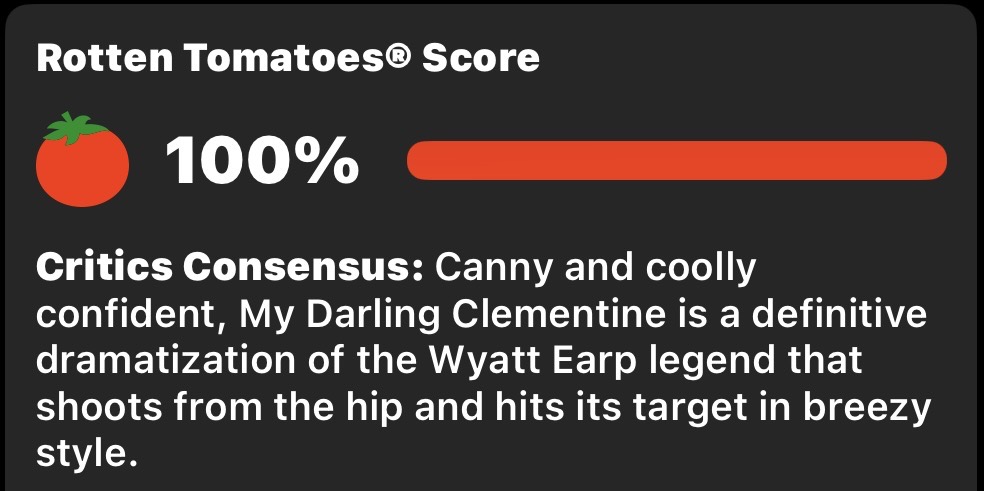
What you might not know is that among academics, My Darling Clementineis accepted as being full of gay innuendo. Homosexual longing and deliberate gay coding are there, unquestioned, a ‘given’ upon which other academic theses are built.18
Bearing in mind this is the film Ford made after reading Stuart Lake’s letter19, and possibly contacting him ….
Well, again, circumstantial. But interesting.
So.
Was Stuart Lake hiding the fact that Wyatt Earp and Doc Holliday were lovers?
We will never know for sure.
Whatever scandalous secret Lake was referring to, he and everyone who knew it, took it to their grave.
 Pre-Order Up Jumped the Devil Today!
- Researching on behalf of Mary Doria Russell. ↩︎
- “Doc Holliday’s Ways” The Dawson News (Dawson GA) Wednesday, February 5, 1896, Vol 12, No 25, Front page. ↩︎
- March 15, 1927 letter held by the University of Arizona Libraries, Special Collections, Walter Noble Burns papers. ↩︎
- “Famous Gun Fighters of the Western Frontier” by W.B. (Bat) Masterson. The Washington Post, Sunday May 5 1907, page 88. (Reprinted from Human Life) ↩︎
- Ditto. ↩︎
- For example, he was Morgan Earp’s roommate while Morgan was waiting for his wife to join him in Tombstone. ↩︎
- Lake, Carolyn ed. Under Cover For Wells Fargo: the unvarnished recollections of Fred Dodge.University of Oklahoma Press (Norman OK), 1969, 1998, p 246. ↩︎
- Waters, Frank. The Earp Brothers of Tombstone, 1960, p 44. ↩︎
- Ditto, p. 108. ↩︎
- Ditto, pp. 224-225. ↩︎
- Lake, Stuart N. Wyatt Earp, Frontier Marshal. p 194. ↩︎
- Ditto, p. 192. ↩︎
- This movie would become My Darling Clementine. ↩︎
- January 12, 1946 letter held by The Lilly Library, Indiana University, in the John Ford MSS. ↩︎
- Kate Holliday had died in 1940. ↩︎
- Allie died in 1947. ↩︎
- Kate complains about this years later. ↩︎
- For example, their first meeting: Wyatt cruises Doc, Doc then buys him champagne and asks Wyatt out on a date. ↩︎
- We know from Ford’s records that he read it. ↩︎
Discover more from Susanne Saville
Subscribe to get the latest posts sent to your email.