
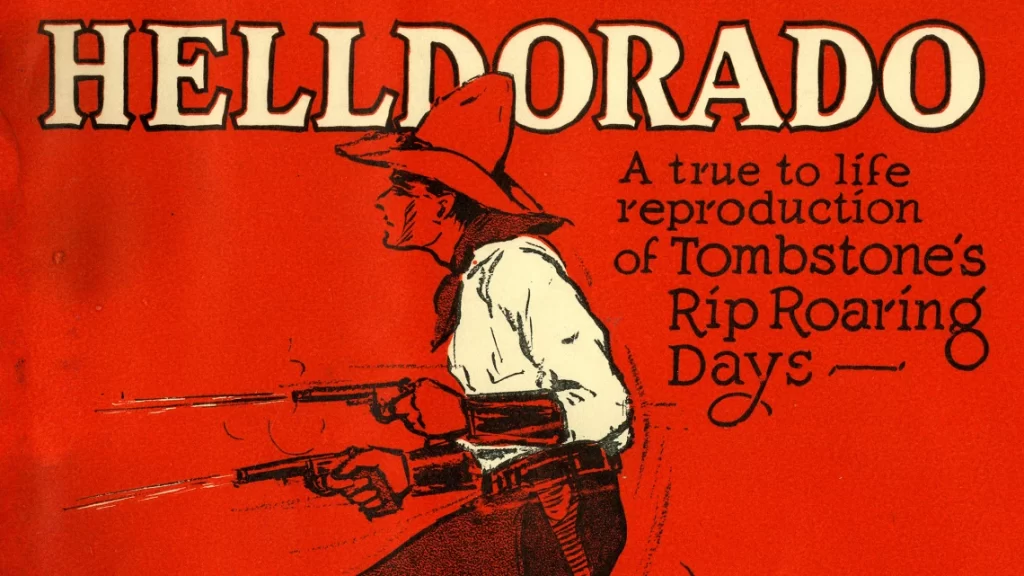
This weekend, October 17 through 19, Tombstone, Arizona celebrates Helldorado Days, a commemoration of Tombstone’s place in the history of the Old West, with street entertainment and food, historical costume fashion shows, gunfight re-enactments, and a parade.
Helldorado was inspired by the book of the same name written by Billy Breakenridge and published in 1928. In the book, Breakenridge recounted his time living in Tombstone in the early 1880s.
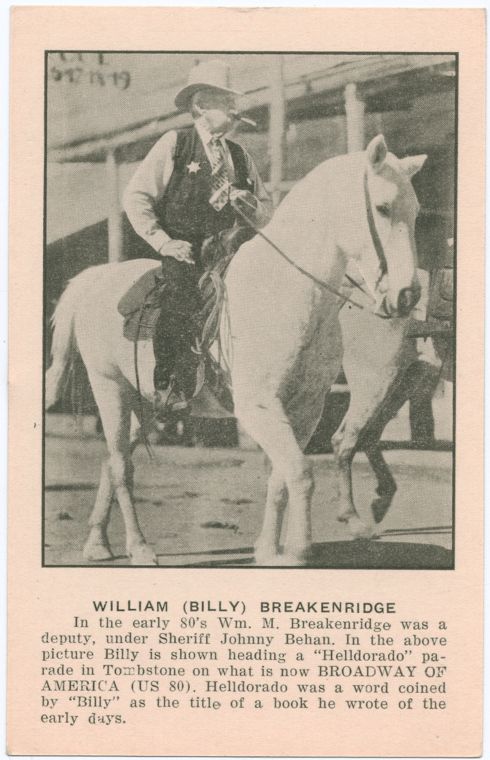
Helldorado was extremely popular upon publication and Billy marched in its namesake parade in 1929. 1
2If you have seen the movie Tombstone (1993) you know Breakenridge. Although you might not realize it.
I have discovered some viewers thought Billy Breakenridge—the man called “Sister Boy” by the Cowboys—was a clerk.
Billy Breakenridge, in real life and in the movie Tombstone, was a DEPUTY to Cochise County Sheriff Johnny Behan. That was his job. He was a lawman.
A lawman said to have been very well-liked by the respectable women of Tombstone for his nice manners and quiet personality.
A lawman also very well-liked by the most influential men in the Cowboy faction, Curly Bill Brocius and Johnny Ringo.
How did a lawman get to be so cozy with the Cowboys?
Since his boss, Johnny Behan, sided with the Cowboys3, it might seem natural for Breakenridge to be biased in their favor. But Breakenridge made up his own mind about the Cowboys. This is his description of Curly Bill Brocius at the time Breakenridge first saw him:
“Curly Bill was lying on a card table. I had never seen him before. He was fully six feet tall, with black curly hair, freckled face, and well built.”4
As Breakenridge watched, Curly Bill raised up on his elbow and shot a glass of water out of an unsuspecting man’s hand as he tried to drink it. The bullet continued through the saloon wall to kill a horse standing outside.
Breakenridge did not introduce himself to Curly Bill Brocius at this time.
When Billy met Curly
Tax collection was one of the duties of the Cochise County Sheriff’s office, often considered the most important duty by the position’s holders because the Sheriff got to keep a percentage of the money collected.
The Cowboys were disinclined to pay their taxes, and no one wanted to disturb that hornets’ nest.
Until, on a tense, thankless, and quite possibly doomed mission, Behan sent Breakenridge out to collect.
When Breakenridge arrived in Galeyville, basically Cowboy HQ, he went directly to Curly Bill and said he wanted to hire him as a deputy assessor, to help collect the tax money and to protect Breakenridge from being robbed of it at any point along the way.
And Curly Bill Brocius laughed.
Appreciating both a good joke and a cunning plan, Curly Bill took Breakenridge around to all the rustlers, warning them he knew exactly how much taxable stuff they had, so not to cheat, and telling them, “We cannot run the county without we pay our taxes.”5
Breakenridge wrote of the experience in Helldorado,
“I was treated fine by all of them, and I never want to travel with a better companion than Curly was on that trip.6”
When Curly Bill was present, Breakenridge felt safe among the rustlers, even sleeping over with them. “It was crowded, and Curly and some of the others divided blankets with me and I slept on the floor with them all night.”7
But not all the Cowboys liked him.
One of the Cowboys, Jim Wallace, insulted Breakenridge to his face and “flourish[ed] his revolver in an aggressive manner” at him. Breakenridge said nothing and quietly left. “Curly Bill, who, it would seem, had a friendly feeling for Breakenridge”8 ordered Wallace to apologize.
Wallace went and found Breakenridge and did apologize. But Curly Bill had continued to drink while he was gone, and when Wallace returned, Curly Bill is quoted as saying, “You damned Lincoln County son of a bitch, I’ll kill you anyhow.” One thing led to another and Wallace, who had previously been friends with Curly Bill “for the past five or six months,” ended up shooting Curly Bill in the face.
“The ball penetrat[ed] the left side of Curly Bill’s neck and…came out the right cheek, not breaking the jaw-bone.”9
Breakenridge immediately arrested Wallace, who was probably glad of it since the Cowboys were threatening to lynch him.
Curly Bill survived that injury, and continued to maintain that Breakenridge was their lawman. No one else seems to have disagreed with him. And truly, Curly Bill wasn’t wrong. When Johnny Ringo had his guns taken away by Behan, for trying to start a street fight with Doc Holliday, Breakenridge gave the guns right back to Ringo, behind Behan’s back.
Was Billy Breakenridge Gay?
So why is Breakenridge called Sister Boy in the movie Tombstone?
The theory that Breakenridge was gay rests mainly on two pieces of primary evidence. Fred Dodge, Morgan Earp’s roommate while Morgan waited for his wife to move to Tombstone, wrote the following to former Tombstone Mayor John Clum after reading Breakenridge’s Helldorado:
“You know Billy and I know Billy. He was in those days a nice girl, and in his declining years should be a nice old lady, instead of trying to make himself a hero of Helldorado.”
Clum shared Dodge’s opinion, responding:10
“I heartily concur in your estimate of the book, Helldorado, — as well as of its author. [italics mine] Poor Billy is now 84 years of age and has only a little time left in which to enjoy his imaginary glory.”
It’s worth noting that the problem Dodge and Clum have with Breakenridge is not the gay part, it’s that this “nice old lady” is pretending to have been a big, tough hellion, and has given himself a larger role in history than he merited.
Both Dodge and Clum believed the toughest lawman in Tombstone was Wyatt Earp.
Wyatt Earp himself never said anything about Breakenridge’s inclinations. He was, however, confused and infuriated by Breakenridge’s Mean Girl mentality.
Breakenridge was nice to Wyatt’s face right up until Helldorado’s publication, then Wyatt discovered he’d been stabbed in the back.
In Breakenridge’s book, the Earps shoot surrendering Cowboys at the OK Corral, executing unarmed men who have their hands up.
Breakenridge’s book also introduces false evidence11 against Doc Holliday, in support of Breakenridge’s contention that Doc was a participant in the attempted stagecoach robbery wherein driver Bud Philpot was murdered.
Wyatt called out Breakenridge’s “dam[n] lies” and wrote, “I can’t just understand him as he has always of late years seemed friendly towards me.”12
You haven’t answered the question…
Does Curly Bill being willing to shoot a friend over an insult to Breakenridge mean something more than camaraderie?
Is sleeping in a big puppy pile with your male friends anything other than an entirely innocent endeavor?
It’s difficult to know. At the time, men sharing beds was fairly common practice in the West. For example, the US Army’s official practice was to barrack soldiers two to a bed.
Wyatt Earp and his partner on Wichita’s police force, Jimmy Cairns13, “literally worked, slept and ate together,” according to Cairns.14 Just in case you don’t think Cairns meant “literally” literally, he apparently proudly repeated these circumstances to many people, as Everybody Knew.
In a letter to Judge John Madden in 1928, David D. Leahy wrote:
“During all of Wyatt Earp’s career here Jimmy Cairns was his partner in service. They were together not only at work but at rest for they slept and roomed together.”15
The specificity of that statement–you’d assume they slept in the same apartment if they were living together, so breaking out that they lived together and slept together–would seem to indicate they shared a bed.
So, yes, it’s entirely possible that these situations were completely platonic.
But just in case you believe men of the 1800s were so pure of thought that no one ever considered sex in these situations, in December 1870, the US Surgeon General criticized the Army’s two-soldiers-in-a-bed practice “in view of the evils” such arrangements “give rise.16“
And they did “give rise.” As in, in December 1889, the New York Medical Journal cited a case of an officer in the United States Army “recently caught in flagrante delicto”17 with an enlisted man.

Did Breakenridge secretly harbor a grudge against Wyatt Earp for killing Curly Bill? Were parts of Helldorado his revenge?
Regardless of the conclusions you draw from this article, while you’re celebrating Helldorado Days in Tombstone, give a thought to its inspiration, Billy Breakenridge.
I’ve been heavily researching Up Jumped the Devil all across the country for about four years now, so yes, I possess A LOT of esoteric (and otherwise useless) knowledge on the topic of Tombstone and its players.
- The red image is the cover of the program for the first Helldorado Days. From: Papers Relating to the First Helldorado, 1929: Celebrating the 50th Anniversary of the Founding of Tombstone, Arizona (AZ 412). Special Collections, University of Arizona Libraries. ↩︎
- This clipping of Billy Breakenridge in the parade is from the Miriam and Ira D. Wallach Division of Art, Prints and Photographs: Print Collection, The New York Public Library. “William (Billy) Breakenridge” The New York Public Library Digital Collections. 1928 – 1931. https://digitalcollections.nypl.org/items/89cb5920-c53b-012f-850e-58d385a7bc34 ↩︎
- Ridiculously abbreviated explanation: Republican town businessmen supported the Earps while the Democrat Ranchers supported Behan. Behan needed the ranchers’ votes as he was county whereas Virgil Earp was city (and US federal) law. ↩︎
- Helldorado, p 130 ↩︎
- Ibid p 132 ↩︎
- Ibid ↩︎
- Ibid p. 143 ↩︎
- Arizona Weekly Star May 26 1881 p 1 ↩︎
- Ibid ↩︎
- Both these quotes are from letters contained within the collections of The Huntington Library, which holds both the Stuart N Lake Papers and the Fred James Dodge Papers. ↩︎
- Breakenridge faked a newspaper quote. ↩︎
- From letter residing within the Stuart N Lake Papers, held at The Huntington Library. ↩︎
- Handsome Scottish immigrant ↩︎
- Benfer, Maurice. “Early Day Law Enforcement Problems in Wichita.” Wichita Eagle Sunday Magazine. 27 January 1929, p 4 ↩︎
- Stuart N Lake had written to Judge Madden for background from locals on Wyatt’s Wichita career, and Madden wrote asking for the tea from primary source Leahy. Leahy letter written November 11, 1928, resides in the Stuart N Lake Papers at The Huntington Library. ↩︎
- Circular Number Four. US War Department, Surgeon General’s Office. December 1870. ↩︎
- New York Medical Journal.December 7 1889. p 625 ↩︎
Discover more from Susanne Saville
Subscribe to get the latest posts sent to your email.