
This blog post started out as a meditation on the cyclical nature of time and the constancy of human nature. It evolved into a quest for truth, and ended in a revelation regarding… the constancy of human nature. It also ended up being a cautionary tale. Let us begin….
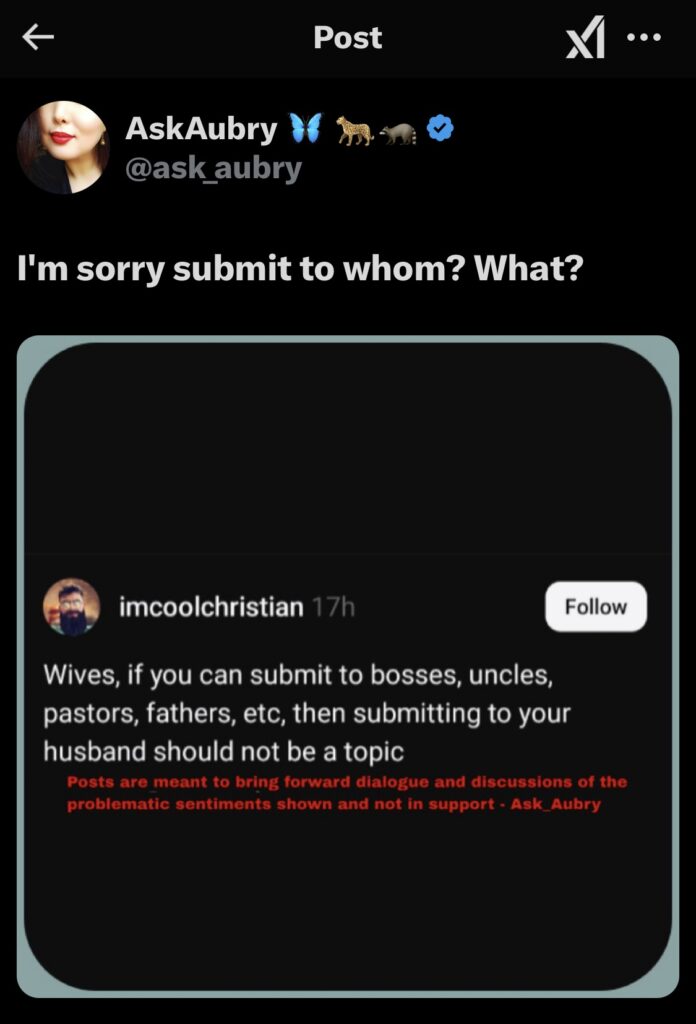
If you spend waaay too much time on the Internet, as I do, you’ll already be familiar with this type of social media post. This women should submit to their husbands talking point generally receives the same reaction as Aubry gives it here.
However, every once in a while, you’ll run across a woman who supports this delusion. Some of these women are agreeing for the grift—they make money off of click bait or by selling an imaginary trad wife lifestyle. Others, often called “Pick me girls,” are agreeing in a desperate bid for attention and approval from these men, even though it means disparaging other women and even womanhood in general.
I was spelunking through Tombstone, Arizona Territory newspapers the other day, and in the course of my research I discovered proof that there have always been “Pick me girls.”

I love that 1880 Tombstone agreed with the Norristown Herald that this treatment of women was complete crap. In fact, the Norristown Herald editor’s rant feels so modern to me, so feminist, I wondered who they were, if perhaps they were female. So I tried to find out.
The first obstacle I ran into was that the Norristown Herald, of Norristown, Pennsylvania, does not appear to be available online. So I could not see the article in its original form.
Or what I thought was its original form.
Okay, first let’s step back and address how a newspaper in Arizona Territory was able to reprint a piece from a newspaper in Pennsylvania.
Early American newspapers sourced stories from outside their locality in many ways. News received from ships arriving in Boston harbor could be sent via horse messenger to newspapers deeper in Massachusetts or up and down the coast. Horse expresses regularly ran news from Philadelphia to New York and New York to Washington DC. The coming of the telegraph made news transmission faster, but not cheaper. (You paid per word to send a telegram.)
So newspapers formed associations in which they pooled their resources. The more members, the more the cost of telegrams was defrayed and the more stories they all had access to. As associations grew, even the smallest community could feel like their newspaper had reporters stationed nationwide.
As it happens, the existence of newspaper associations—or of one such association in particular—had a direct influence on the nationwide impact of the Gunfight at the OK Corral. 1
This particular news association was the Associated Press. In 1880, the AP had members from Dakota Territory to California to Texas to Maine, and that summer the Arizona Territory, in the form of the Tombstone Epitaph, joined them. This meant that on October 26, 1881, a violent street fight in a remote corner of an American territory was reported across the nation in as close and timely a fashion as your local news. The subsequent saga was also closely followed in newspapers across the country, thanks to the availability of the stories through the Associated Press, and this led to President Chester Arthur mentioning the Cowboy threat in his State of the Union address. President Arthur would later consider calling for martial law to deal with Cowboy violence.
But back to the Norristown Herald quest.
In the course of discovering that I could not find the Norristown Herald online, I found their article in other newspapers besides the Tombstone Epitaph. The Evening Starof Washington DC printed it on 17 September 1880, and credited the Norristown Herald.
But the Indiana State Sentinelran a slightly different version of the same story on 11 August 1880 without crediting anyone.
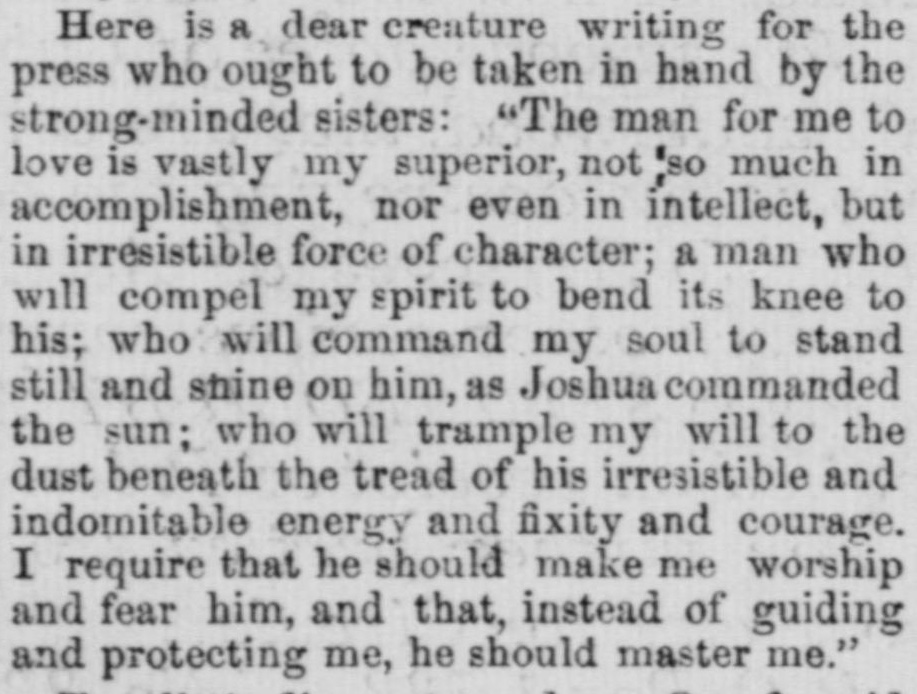
And the Memphis Daily Appealran the story, uncredited, on 26 May 1880 in this format:

While the editorial comment is still admirably modern, the varying descriptions of the alleged girl writing this–“dear creature” or “lady who says she is young and handsome”?–seems… odd. So I expanded my search and…

KIRKCUDBRIGHTSHIRE?? Okay, Scotland.
So it’s yet another version of the article, and still uncredited. But now I know that it was printed in UK newspapers as well. Time to search the United Kingdom. And…
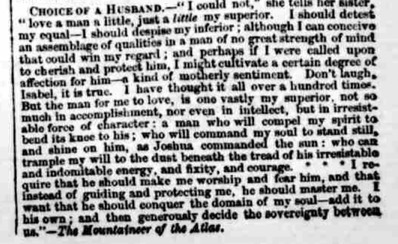
A breakthrough! The Birmingham Journal printed the story back in 1851 AND they CREDITED where they got it. So now I need to find out where the Mountaineer of the Atlas newspaper is published and I might finally find the origin of this story.
Well. It turns out the Mountaineer of the Atlas isn’t a newspaper. It’s a book.
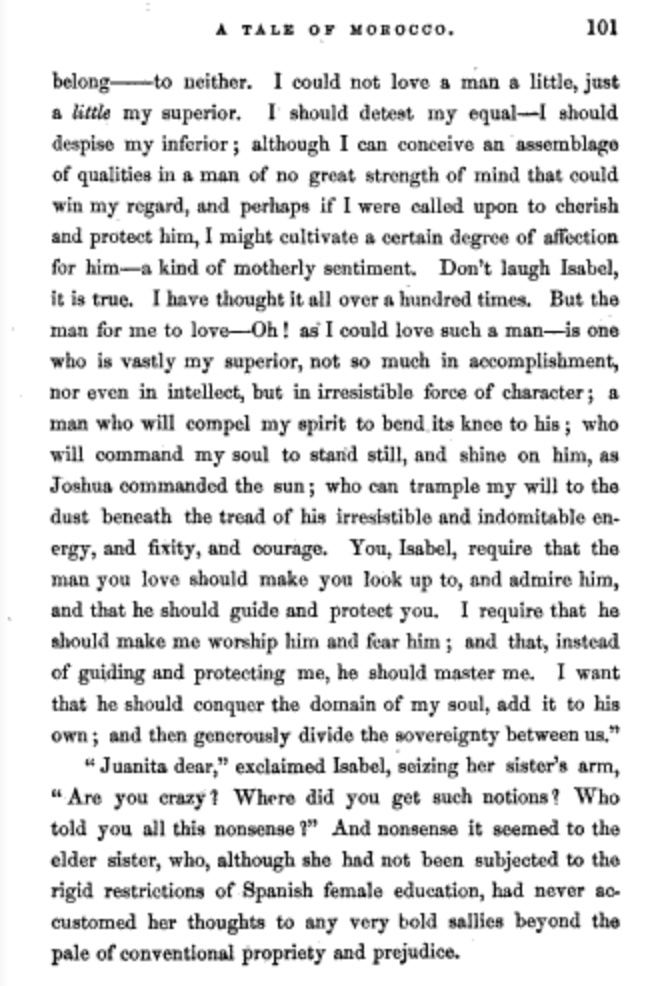
So. The girl declaring she desires to be dominated, conquered by her man IS FICTIONAL and, moreover, WRITTEN BY A MAN.
Thus we have come full circle, with a man writing that women should submit.
Of course, the author did have the other woman in the scene respond to this girl’s declaration with, “Are you crazy?” so maybe it’s still feminist. I haven’t read the book, so I don’t know which of these women we’re supposed to side with.
By the way, did you notice that this saga also revealed that even primary sources can be unreliable narrators? Historians give great weight to primary sources–documents from the time, first hand accounts from people who would have direct knowledge of the circumstances being researched, etc. But if I had taken the newspaper article from 1880 Tombstone as evidence that some Victorian women believed in being conquered by their husbands, even though it is a primary document, I would have been totally wrong.
Hence why I called this a cautionary tale.
- Why am I throwing this random knowledge in here? Because the reason I’m researching in the Epitaph in the first place is I’m working on this book:
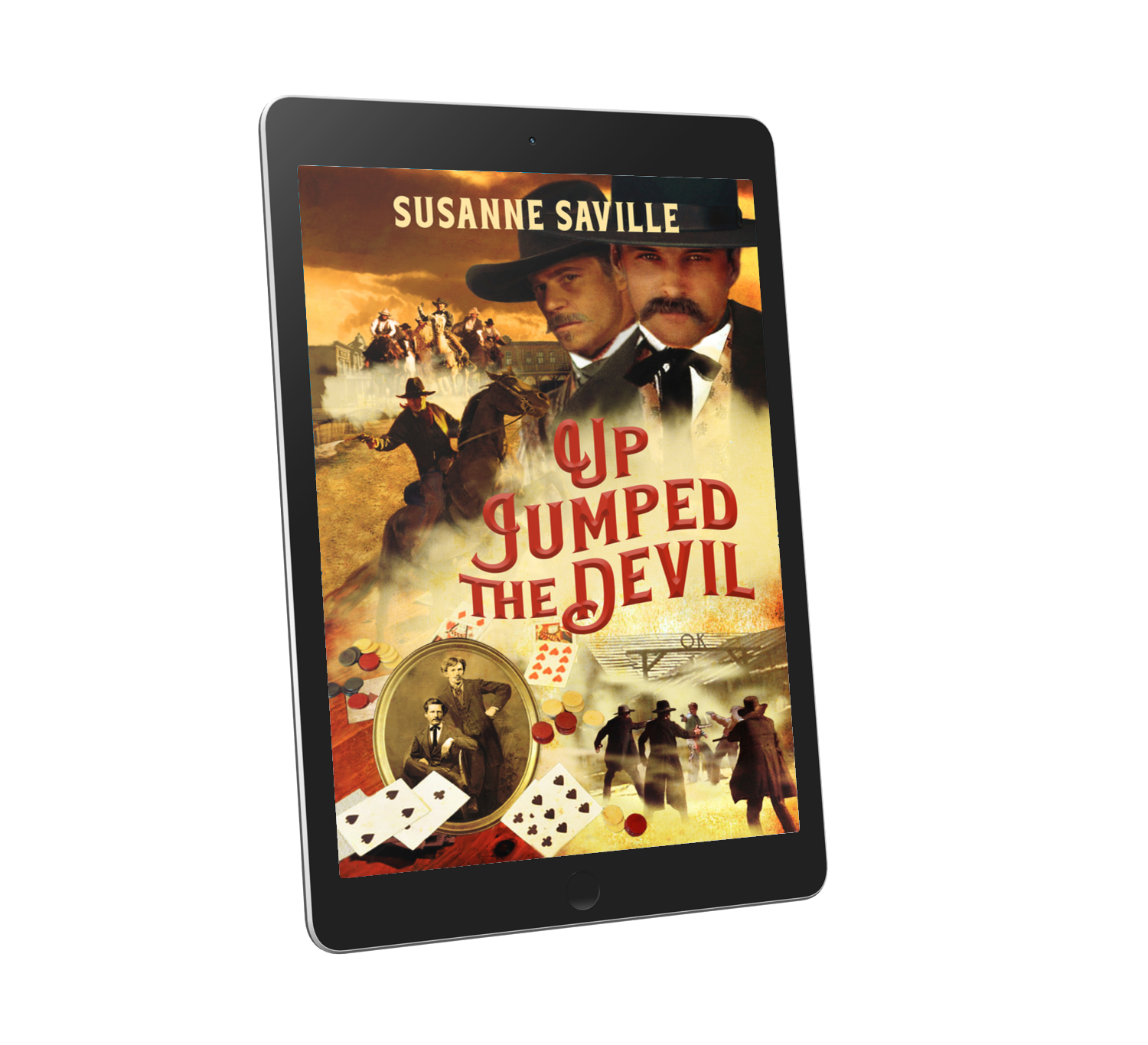 Is it fiction? Yes. Am I hyper fixating on grounding it in the most inordinate amount of research possible? You betcha. ↩︎
Discover more from Susanne Saville
Subscribe to get the latest posts sent to your email.